Mapa de textures
- When:
-
—
Opening: February 21st 2026, 12 h
- Location:
- Espai Cultural Sa Punta des Molí. Sant Antoni de Portmany. Eivissa.
- Artists:
- Alberto Baraya, Adrián Martínez, Vítor Mejuto, Rosell Meseguer, Isabel Servera
- Curatorship:
- Pilar Rubí
Whether tactile or visual, the texture of matter is the physical quality of the surface of objects. This aspect, which can be rough or smooth, coarse or soft, partly defines our world. Texture also alludes to the act of weaving. It is synonymous with warp and weft, thus evoking a specific arrangement of elements, threads or strands, that will form a fabric. Furthermore, texture refers to the quality of linguistic cohesion contained in a written text.
The works of Alberto Baraya, Adrián Martínez, Vítor Mejuto, Rosell Meseguer, and Isabel Servera are part of this exhibition and form a unique map of textures that unfolds within the domestic space of a traditional Ibizan house, now the Sa Punta des Molí exhibition center in Sant Antoni de Portmany, where Walter Benjamin lived during his time in Ibiza in the early 1930s. All the works are linked by an invisible thread that connects the themes and discourses addressed by the Biennal B* program, an initiative promoted by Es Baluard Museu d’Art Contemporani de Palma and the Consell de Mallorca.
A distinctive and abstract Pangea, like a tapestry, welcomes visitors as soon as they cross the threshold of the former house, now an exhibition center. This is Rosell Meseguer’s Mallorcan Geology a large-format study on canvas, based on research into the metallic and non-metallic mineral resources of Mallorca, translated into painting and inspired by Quadra minerale: tierras raras, otros minerales y conceptos de minería; un acercamiento a los elementos y sus usos en la contemporaneidad that he carried out between 2017 and 2021. Meseguer’s work unites scientific knowledge and art. Her chromatic textures can be seen horizontally and from top to bottom: marès, black quartz, malachite, azurite and chalcopyrite that correspond to ochres, greens and blues, unconsciously evoking the matter found in an imagined mineral sea, in the countryside, in the earth.
It is precisely from the land that the palm fronds are extracted, which, when treated, give rise to the plait, the braided esparto strips traditionally used to make baskets and other household objects, both in Ibiza and Mallorca. In the Artà area, where Isabel Servera’s family is from, the creation of textures by hand is often done in groups, talking or singing, sometimes alone and in silence. The repetition of gestures becomes prayer, mantra, breath. A rhythm that the artist transforms into a series of pieces called Alenades (breaths), to which another distinct rhythm is added: that of machine sewing. The piece we see here is organic; it seems as if it might disintegrate. It rests in a niche, without adhering to any pattern. It is perhaps the material translation of that act which, by inhaling and exhaling, transforms the exterior into the interior and vice versa. In the artist’s words, it evokes both the physical effort of the process and the vitality of the material.
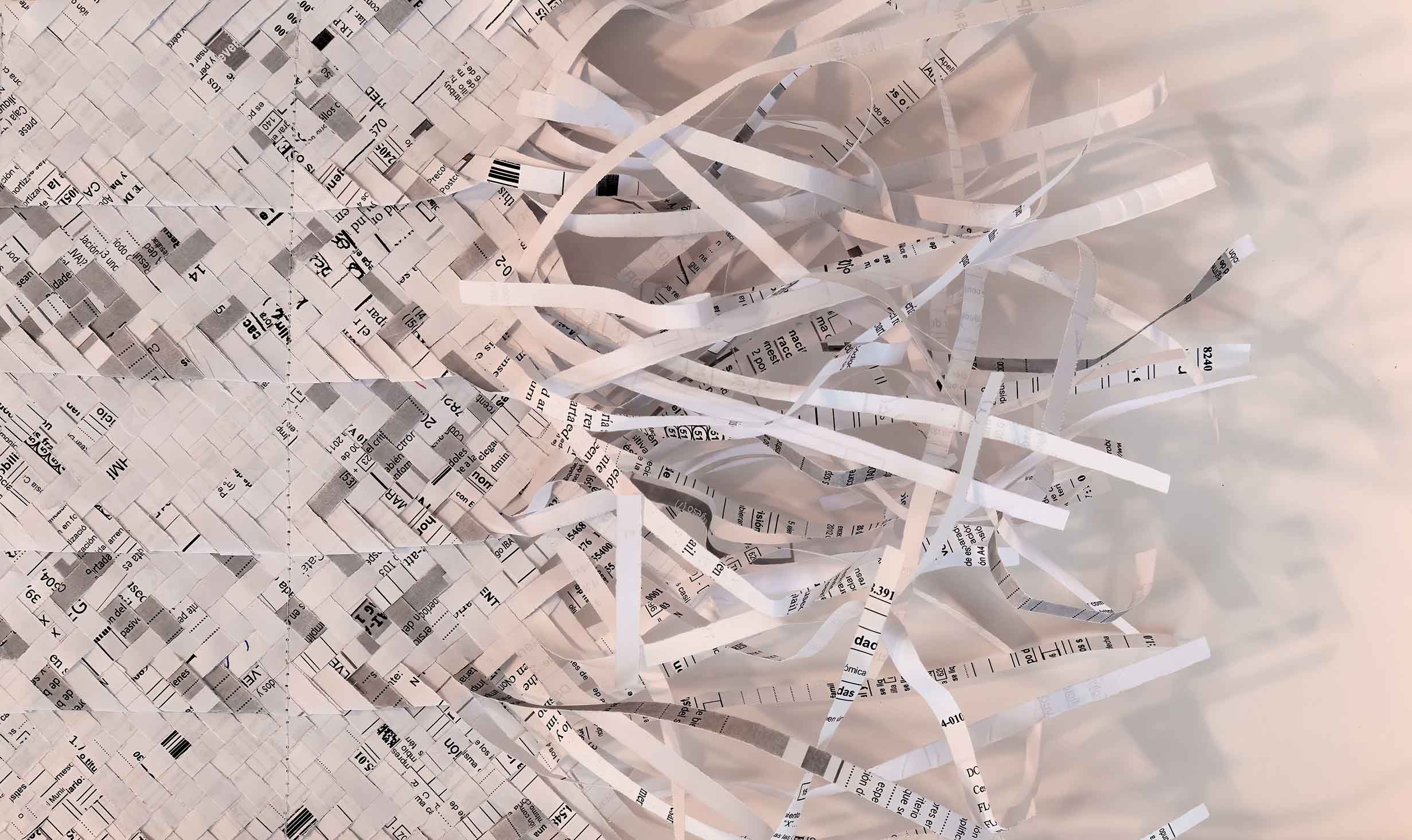
In close connection with the sculpture Alenades, we find a series of works made of braided paper in the style of the llatra or llata, which evoke old samples of how to work with palm leaves, while simultaneously presenting us with antagonistic struggles inherent in the human experience: order versus chaos, the natural versus the artificial, the made versus the found, the finished and the unfinished, in an eternal, unresolved chain. The texture contains the text, now indecipherable, as its form changes by recycling the paper as raw material.
The subtlety of the material in Isabel Servera’s work becomes powerful in that of Adrián Martínez. His drawings leap from the usual formats of his work on paper or canvas, emerging reinforced by a support that enhances them: a felt with an irregular and rough texture. This is the result of a collaboration with the circular factory Llanatura, which transforms and recycles sheep’s wool that would otherwise be discarded. The materials evoke the perceptible, the tactile, and the connection to the earth. The artist’s two drawings, now on metal structures, with front and back, become windows into the difficult, solitary, and often precarious life of the creator, imbued with subtle irony and a touch of fresh humor.
Explicitly connected to the site and specifically conceived for this exhibition are the works of Vítor Mejuto. They translate, in geometrically shaped paintings with a smooth texture, three significant elements of tradition and craftsmanship, focusing on the typical clothing of Ibiza and Formentera: the barretina (a traditional Catalan cap), castanets, and handmade esparto grass sandals. His work intelligently manages to express the cultural identity of a territory with a minimal number of elements. One of his paintings can also be seen in the trull, the adjacent building.
The olive press (trull) is in a completely renovated building, which still retains the old press to make oil. This architectural volume faces the mill that gives the complex its name (Sa Punta des Molí) but also the sea. It is precisely on the coast of Mallorca where Alberto Baraya carries out a performance piece documented in the video of his project “Llatina i Mestral” within Biennal B, in which the artist paints on-site on a sailing sail during the voyage. The sail is transformed into a canvas on which to paint while also serving as a support for a double journey—physical on the sea and iconographic or conceptual—that turns the island into a stage. Baraya traveled on a historic llaüt, a traditional boat that Mejuto synthesizes in three colors in the painting that brings this unique map of textures to a close, uniting practices and knowledge to connect different places on each of the islands.
*Biennal B is a cross-cutting program of activities that was created with the aim of integrating contemporary artistic practices with crafts, science and design, through exhibitions, site-specific interventions and performative actions, to foster collaboration between artists and craft professionals committed to sustainable development, trades, traditions and the landscape of the Balearic Islands.
Adrián Martínez (Eivissa, 1984) has a degree in Fine Arts from the University of La Laguna, Tenerife. He currently lives and works in Mallorca. Martínez has developed his artistic activity through drawing, understood as a process of research and understanding resulting from his desire to narrate certain stories, reflect on everyday life and question his artistic practice. The materials used in his pieces range from graphite on wall, iron and wool to animation/sound, and each of these materials has its own language, providing various layers and depths to the work.
His solo exhibitions include shows at Galería Ferran Cano, Barcelona and Palma (Mallorca); Sala de Arte Cabrera Pinto, La Laguna, Tenerife, and Ateneo de La Laguna, Tenerife. He has participated in numerous group exhibitions in: Casal Solleric, Palma, Mallorca; La Regenta, Las Palmas de Gran Canaria; MACE, Eivissa; TEA, Tenerife; Círculo de Bellas Artes, Madrid; Es Baluard Museu, Palma, Mallorca; MUU Kaapeli, Helsinki; Centro de Arte La Recova, Tenerife and Sala de Arte Cabrera Pinto, La Laguna. His work can be found in various public and private collections: MACE, Museu d’art Contemporani d’Eivissa; Fundación Mapfre Guanarteme; Ayuntamiento de Manacor, Ayuntamiento de Santanyí, Gobierno de Canarias and Universidad de La Laguna. In 2022, he was awarded the 25th Premi Ciutat de Manacor d’Arts Plàstiques. In 2024, he received the award at the Premio Vila de Santanyí Francisco Bernareggi de Artes Visuales and participated in BIAM 2024, Bienal de Arte Ciudad de Amposta at the Centre Lo Pati.
Alberto Baraya (Bogotá 1968), visual artist, traveller and researcher. He studied Fine Arts at the Universidad Nacional de Colombia and specialised in Aesthetics and Art Theory at the Universidad Autónoma de Madrid. Since 2002 he has developed the “Herbarium of Artificial Plants”, a parodic project of collections and “studies” of fake botany, wire and silk, made in China, with which Baraya tries to recompose a new identity in the relations between man and nature.
Practising the principle “Of expedition as one of the Fine Arts” and appropriating the scientific methodology of collecting as a strategy, Baraya has undertaken expeditions around the world in search of evidence of the transformation of biological and cultural ecosystems. Through the use of traditional techniques of representation or through installation, appropriation or performance, his gaze falls on the observation of phenomena of biological exoticism or on the aesthetic acts of our everyday ecosystem, thus linking his proposals with contemporary ecological concerns.
His artificial collections and photographic works have been presented at the art Biennals of Sao Paulo (2006), Venice (2009), Berlin (2014) and Shanghai (2014 and 2019), and can be found in many public and private collections.
Vítor Mejuto (Barcelona, 1969) is a painter and photographer currently working as art director director at La Voz de Galicia. Having studied in the Fine Arts Department at the University of Salamanca in the late 1980s, his artistic practice is essentially pictorial. His most notable exhibition projects include “Pintor en la Corte” (Formatocomodo Gallery, Madrid, 2018), “O livro das Palmeiras” (Fernando Santos Gallery, Porto, 2018), “Torreón de tramoya” (Centro Párraga, Murcia, 2020), “Artanenc” (Igallery, Palma, Mallorca, 2022), “Un viaje extraordinario” (Centrocentro, Madrid, 2023) and “Vida y Milagros” (Espacio Valverde, Madrid, 2024).
Also worth mentioning is his recent residency at the Projeto Fidalga Residência in São Paulo, resulting in the “Copo Americano” exhibition, and his Quadern d’Artà project, a public space intervention in Artà, Mallorca.
Isabel Servera (Mallorca, 1986). Her artistic practice focuses on predetermined actions involving manual processes of repetition, accumulation, and routines. She uses different resources, proposing a dialogue between art and craft processes. She holds a BA in Fine Arts and a Master’s degree in Artistic Production and Research from the University of Barcelona. She has an extensive artistic career, having exhibited in various national and international museums and galleries such as: Palau de Casavells (Girona, Spain, 2023), Studio Weil (Port d’Andratx, Mallorca, Spain, 2022), Alzueta Gallery (Barcelona, Spain, 2020), Can Framis Museum – Vila Casas Foundation (Barcelona, Spain, 2019), Hilvaria Studio’s (Hilvarenbeek, The Netherlands, 2015), Es Baluard Museum (Palma de Mallorca, Spain, 2014), Muu Galleria (Helsinki, Finland, 2014), L.A.C Lieu d’Art Contemporain (Sigean, France, 2013), among others. Recently, she was awarded the II Barbara H. Weil Prize, through which she completed an artistic residency in New York. Her work is included in collections such as: Palma City Council, Vila Casas Foundation, Banco Sabadell Foundation and DKV Collection.
Rosell Meseguer(Orihuela, 1976). Visual artist and PhD, Extraordinary Doctorate Award in Fine Arts from the Complutense University of Madrid, where she is a PhD mentor and supervisor as well as part of research groups. She has been awarded several grants by the Academy of Spain in Rome, the Botin Foundation, the Miró Mallorca Foundation. She has been invited and has received commissions by institutions such as the Ministry of Culture and Sports, Spain; AC/E, Acción Cultural Española AC/E; Spanish Agency for International Development Cooperation (AECID) ; Manifesta, International Foundation Manifesta (IFM), Netherlands (2010-2011),Plat(t)Form, Winthertur, Zurich; Ministry of Culture, Arts and Heritage, Chile; or the ArtCenter/South Florida, Miami.
Her work is in collections such as C.A.2M. Centro de Arte Dos de Mayo Madrid; AENA Foundation; Royal Academy of Spain in Rome; UNICAJA or IVAM, Valencia as well as in private collections in the United States (Board Whitney Museum, New York), Latin America (MAC Museum of ArtContemporáne of Santiago de Chile) and Spain (Seguros DKV).