Aitor Ortiz: Gaudí at Palma Cathedral
- When:
-
—
Opening: 17th November 2026, 6 pm Can Balaguer / 7.30 pm Es Baluard Museu
- Location:
- Es Baluard Museu – Espai Biennal B
Photography of architecture, and especially that of Antoni Gaudí, is a specific challenge, raising an inevitable question: what can a fresh gaze offer for subjects so widely photographed?
Antoni Gaudí’s architecture has for decades been one of the most photographed in the world, leaving us with a vast bibliography. Images taken by photographers, whether professional or amateur, arouse in those viewing them the desire to appreciate these buildings directly, moving millions of people from the most faraway nations on the planet to the sites where these architectural works are found, leading to new images.
The logical consequence of this avalanche of photographic imagery is that it is difficult, if not impossible, to take different pictures, images that have never previously been made and distributed. This fact means that the depiction of Gaudí’s work occupies a place, in terms of real knowledge, over and above the architecture itself.
Many architectures we consider to be iconic and recognisable have in fact been visited by a small percentage of the total number of people able to identify them. Photography, on the other hand, played a decisive role in propagating information about these architectural styles, through habitual publication in professional magazines.
If architectural experience is found within and around specific architectural projects, feeling and inhabiting them however fleetingly, what architectural photography offers is a visual and aesthetic experience, while also providing concrete data on the building being photographed.
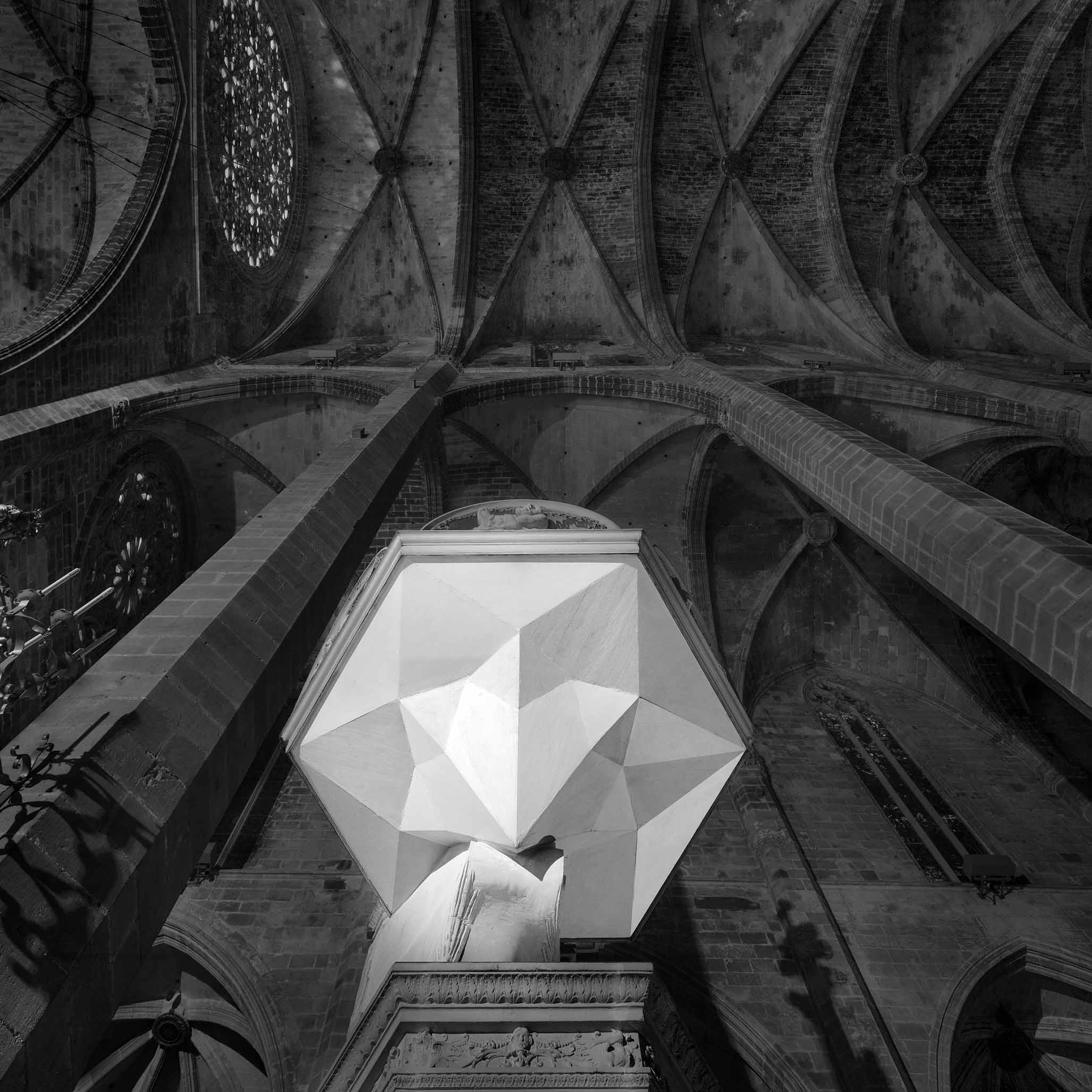
Aitor Ortiz accepted the challenge of photographing the architecture of the Catalan genius, seeking to explain something that until now had not been seen in the same way. He did not set out to capture still-unphotographed traits (something perhaps impossible), but to look at them with a modicum of austerity and distance. At the same time, he quite subtly shows us the Gaudí who shifted between the historical craft tradition and the technological modernity of his time, focusing on the importance of his laboratory-workshop, the generative space of his creative process. By eliminating the rhetoric of colour and exploring details in depth, Ortiz reveals a Gaudí who was surprisingly current and modern for his time, while for his part staying true to the trademark language of his photographic practice to the present. The verve of Gaudí and the gaze of Ortiz set up a dialogue where both are able to demonstrate their qualities, intact yet enhanced.
The exhibition includes 18 smaller-sized pieces shown in classic formats, though presented using fully contemporary printing and hanging procedures. They stand out for their muted presence, turning the visual quietude enveloping them into a feature element, like in the music of Frederic Mompou; between two intimate sonorities, or perhaps, two silent images.
Aitor Ortiz (Bilbao, 1971). Since 1995, Ortiz has photographed architecture, transcending the document itself. Accentuating the factor of the dissolution and transmutation of the real as associated with photographic representation, Aitor Ortiz produces starting points for reflection on a set of visual and cognitive uncertainties, through space, architecture and objects. His work has been shown in solo exhibitions at the Museo de la Universidad de Navarra (Pamplona, 2018), Le Centquatre (Paris, 2015), Canal de Isabel II (Madrid, 2013) and Fotografiska: The Contemporary Museum of Photography, Art & Culture (Stockholm, 2011), among others. His work is present in the collections of Museo Nacional Centro de Arte Reina Sofía, Colección Masaveu, Es Baluard Museu, Museo BBAA Bilbao, Museo Guggenheim Bilbao and the Contemporary Art Collection of Fundació ”la Caixa”.