Fabrizio Plessi. Digital Splash
- When:
-
—
Opening: September, 15th 2026, 8:30pm
- Location:
- Museu de Mallorca, Palma
- Curatorship:
- David Barro y Jackie Herbst
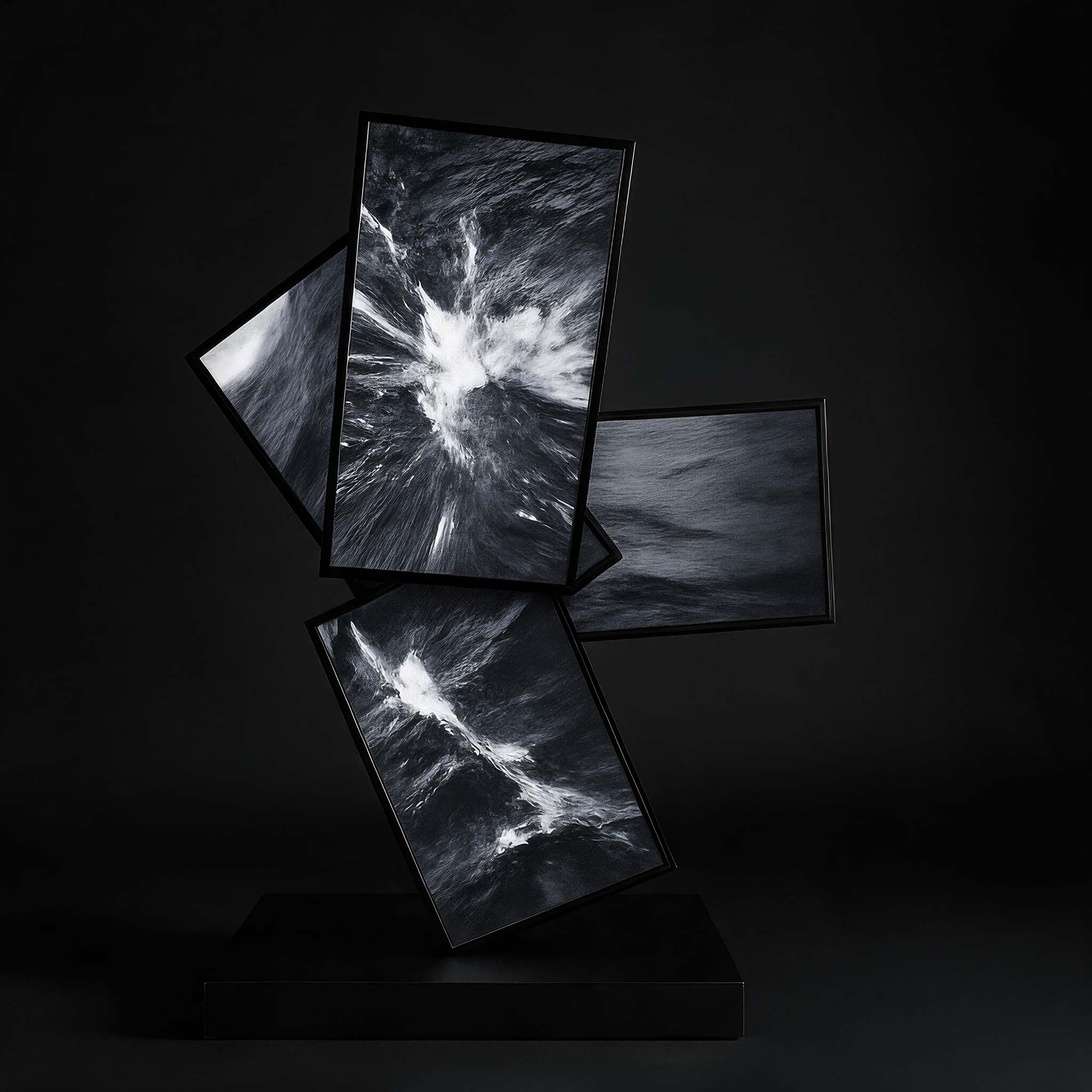
Fabrizio Plessi always endowed his work with a distinctive emotional elasticity, thanks to his acute sensitivity to the physical properties of each material. His practice has been shaped by his historical awareness, memory and engagement with elemental forces of nature such as water and fire. This is evident both in the paradoxical complexity that can emerge from something as simple as a pencil and in his uninhibited embrace of technology, which has enabled him to measure and apprehend space while exploring the political and social undercurrents of his time. This unique approach is clearly visible in “Digital Splash”, an exhibition at the Museu de Mallorca produced in collaboration with Es Baluard Museu and the Consell de Mallorca as part of BIENNAL B, featuring a large-scale video installation and a series of drawings entitled “Black Splash”.
Everything stems from a reiteration: every minute a rock falls onto a sculpture and shatters it. Water then escapes from the sculpture, defying all logic. The work itself also escapes its physical form through artificial intelligence. Once again, Plessi experiments with form and material, always keen to humanise technology and create destabilising tensions. And repetition here isn’t confined to the fracturing sheets but also extends to the spaces of the windows, recurring and unfolding in sequence with their respective LED screens. It becomes a measure of the abyss of a life that spills over without end. The sensation is overwhelming and immense. There is no rhetoric, only an inescapable metaphorical immersion that addresses us physically and asserts itself mentally through its fractal dimension. The image is pushed to an extreme and shapes a space of its own. Guided by the image, the spectator must find a way to move through or draw closer to its different scales. Plessi brings us to a fissure in our perception. There are no certainties. Language becomes a site of disjunction, a liquid shadow, a penetration into the unsayable. The image exhausts itself. Water makes itself felt. Time is liquid. The terrain fractures.
Meanwhile, in his drawings, which reveal the artist’s creative process while retaining an autonomous presence of their own, Plessi leads us through different registers of the same sensation. Questions of style and compositional balance are never neglected. The encounter is always unexpected and unpredictable. The physicality of drawing itself also exceeds its limits in a kind of baroque proliferation, unfolding like the singular echo of a single acoustic signal. Drawn, erased, splashed, measured . . . These works become a form of translating the artist’s mental landscape, which the spectator has to reconstruct and amplify to reveal obscure, secret zones where the protected idea lies concealed within a kind of interstitial palimpsest. All the while, large, black iron sheets continue to fall and splash with a thick, dense, ambiguous and fragmentary force, producing an enigmatic spatial dislocation. Behind it all lies the terrain of life itself, which splashes over us cyclically, even as we strive to see and care for everything even more intensely.
Fabrizio Plessi (Reggio Emilia, Italy, 1940 – Venice, 2026) has been a pioneering figure in video art and installation. His work, developed since the late 1960s, explores the relationship between nature and technology, with water and fire among his central motifs. His most notable exhibitions and projects include the Venice Biennale, in several editions (1970, 1972, 1976, 1980, 1986, 1993 and 2011); documenta 8, Kassel (1987); Centre Pompidou, Paris (1982); Musée d’Art Moderne de Lille Métropole, Villeneuve-d’Ascq (1984); Kunsthistorisches Museum, Vienna (1998); Solomon R. Guggenheim Museum, New York (1998); Museum of Contemporary Art, San Diego (1998); Scuderie del Quirinale, Rome (2002); Martin-Gropius-Bau, Berlin (2004); Museo Correr, Venice (2001, 2020); Piazza San Marco, Venice (2020); and Palazzo Reale, Milan (2023), among others.
Throughout his career, he received numerous accolades, including the UNESCO Miró Medal (1993) and the Kunstpreis der Norddeutschen Landesbank (1999). His work is included in important public and private collections.
He also developed an extensive teaching career, particularly focused on experimentation with new technologies and audiovisual languages. In 1989, he was one of the founders of the Kunsthochschule für Medien Köln (KHM) in Cologne, where he established the Chair of Electronic Scenography. In 1994, he also founded the Chair of Electronic Scenography, of which he served as chairholder. His artistic practice also extended into theatre, architecture and public space.