Ghada Amer. Sculpture Since 1991
- Location:
- Exhibition Hall A
- Opening:
- Artist:
- Ghada Amer
- Curatorship:
- Clara Garau and David Barro
- Downloads:
A pioneer in the distinctive way she approaches painting and ceramic sculpture, Ghada Amer understands perception as something that never exists in isolation. Beyond the artworks themselves, she offers us a way of seeing the world through them. For Amer, the ability to recognise ambiguity is a revolutionary position. Her work is not didactic, but she believes in the power of beauty and insight to expose injustice and contradiction. In this sense, her art is political, although its message is rarely direct; instead, she creates space for reflection and critical awareness. The overlapping personal, cultural, political and social spheres make every painted, embroidered or sculpted detail meaningful.
Born in Cairo, raised in Nice and based for several decades now in New York, Amer is best known for paintings in which she stitches erotic or pornographic images onto the canvas, blurring their appearance and redirecting pleasure away from the sensual charge of the iconography towards the visual delight of the thread. Everything becomes less clear without ever disappearing, like a mise en abyme drawing us into a conceptual paradox. The image tumbles into and becomes encrypted within a kind of enigmatic abyss. For the message in Amer’s work is never delivered literally: it comes from a site of contradiction, or what Jacques Rancière called the “in-between space”, the space between extremes: the in-between becomes a space of difference, a passage between something and something else. It is a path between two images, two genders, two ways of facing the world, between different territories and ways of seeing or between different artistic disciplines such as sculpture and painting. Amer’s vision is closely connected to transculturalism and the importance of cultural exchange. Her choice of techniques and materials offers a clear example: her stitched paintings remind us that weaving has long since moved beyond the domestic sphere to become a political tool against forgetting; her ceramic sculptures are uncontrollable and liberating; her bronzes are as stable as many of the convictions the artist seeks to dismantle.
Amer’s work takes shape at boundaries and creates a feeling of suspended time. Since her pieces cannot be fully apprehended at once, the viewer’s gaze is in constant motion, like the water flowing from the fountains she has produced in collaboration with Pere Coll’s pottery workshop in Mallorca. This is her way of fracturing the image, while sheltering its mystery and reinforcing its density. The same approach can be seen in the layout of her exhibition at Es Baluard Museu, where her paravents, or folding screens, act as solid barriers that both protect and contain the images. They compel us to move closer and embrace the unabashedly explicit figures, created upfront in relief. The sense of desire is never quite clear and the sense of awareness is disconcerting: what was originally conceived to conceal becomes a means of revelation.
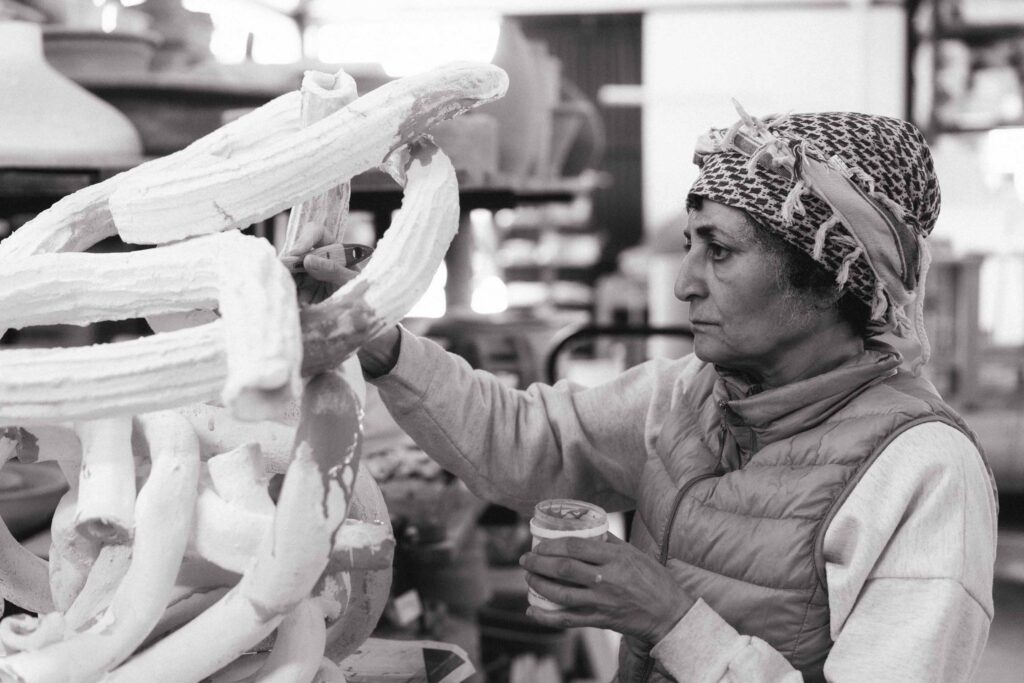
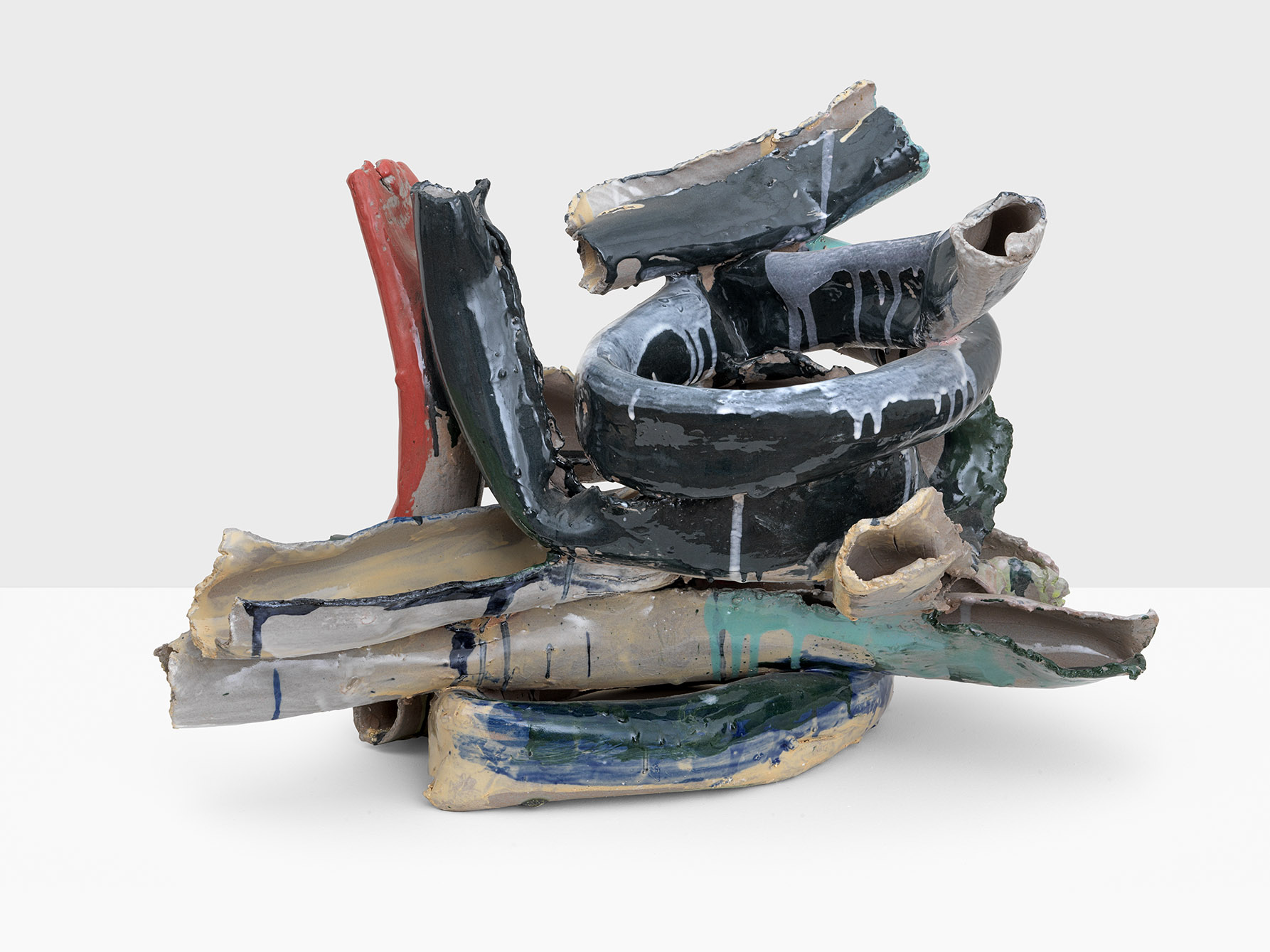
This ambivalent gaze makes her sculpted paintings or painted sculptures feel radically contemporary. Yet behind all this, as is paradoxically apparent in her ceramic sculptures, her works are grounded in the act of painting itself. Where her embroidered paintings opened up a space for reflection on painting as a medium and on what painting could become, her pictorial approach to ceramics, together with the unpredictability of its forms and colours, allows her to pursue an even greater poetic intensity. Amer has been producing sculptures with a strong painterly character and striking chromatic appeal for many years. This is hardly new when we recall how the sculptures of antiquity were painted; think of the legacy of polychrome sculptures from ancient Egypt, which have reached us with their colours still visible, though worn by the passage of time. Her Thoughts, meanwhile, bring her closer to abstraction in a distinctive manner. The process of making the work allows her to accompany her thoughts, while painting, through ceramics, loses its central position and begins to dissolve. Through painting and sculpture, Ghada Amer seeks to make the viewer more sensitive and aware, and by veiling and blurring the image, she emphasises how difficult it can be to understand what we see in the contemporary world.
Ghada Amer was born in Cairo, Egypt, in 1963 and moved to Nice with her parents at the age of 11. She remained in France to continue her education and, after completing her undergraduate studies, she earned an MA in Fine Arts at Villa Arson, École nationale supérieure de Nice, in 1989. During this period, in 1987, she studied sculpture for two semesters at the School of the Museum of Fine Arts in Boston, Massachusetts. In 1991 she moved to Paris to undertake a postgraduate programme at the Institut des hautes études en arts plastiques. In 1996 she was accepted onto an artist residency at the University of North Carolina at Chapel Hill. She has since lived and worked between New York and Cairo.
Ghada Amer is one of the most widely recognised artists of her generation. Her work has been presented at a number of major public institutions, including two retrospectives: one at Mucem, the Musée des civilisations de l’Europe et de la Méditerranée in Marseille, curated by Hélia Paukner, in 2022, and another at the Brooklyn Museum in New York, curated by Maura Reilly, in 2008. Other exhibitions have been held at the Centre Pompidou-Metz, 2025; The Metropolitan Museum of Art, New York, 2024; the Stedelijk Museum, Amsterdam, 2024; Desert X, Palm Springs, California, 2021; Louvre Abu Dhabi, 2021; MAZ, Museo de Arte de Zapopan, Jalisco, Mexico, 2020; the Brooklyn Museum, 2018; the Smithsonian National Museum of African Art, Washington, D. C., 2017; MACRO, Museo d’Arte Contemporanea Roma, 2007; the Stedelijk Museum ’s-Hertogenbosch, Amsterdam, 2006; The Museum of Modern Art, New York, 2006; and the Centre Georges Pompidou, Paris, 2004.
Amer’s work is held in public collections around the world, including Mathaf: Arab Museum of Modern Art, Doha; the Art Institute of Chicago; the Barjeel Art Foundation, Sharjah, United Arab Emirates; the Brooklyn Museum; the Centre Georges Pompidou; the Crystal Bridges Museum of American Art, Bentonville, Arkansas; Guggenheim Abu Dhabi; the Israel Museum, Jerusalem; and the Samsung Museum, Seoul. She has also participated in major international group exhibitions and biennials, including the Whitney Biennial in 2000 and the Venice Biennale in 1999 (when she was awarded the UNESCO Prize), 2005 and 2007.