Luis Camnitzer: The Dictionary of Power, the Resurrection of Simón Rodríguez
- Location:
- Exhibition Hall B
- Opening:
- Artist:
- Luis Camnitzer
- Curatorship:
- Mariana Silva
What words do we use to talk about power? Who decides what they mean? Can words change the way we see the world?
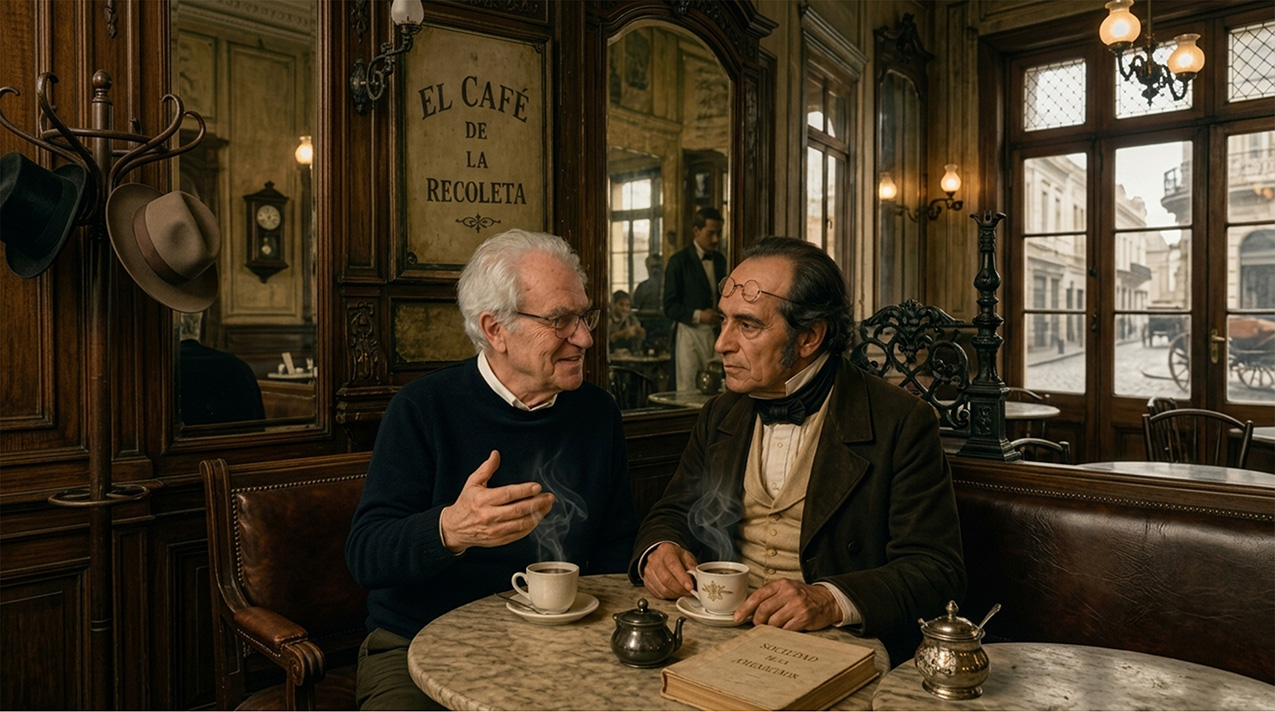
“The Dictionary of Power: The Resurrection of Simón Rodríguez” stems from the links between the critical thinking of Simón Rodríguez (Caracas, Venezuela, 1769 – Amotape, Peru, 1854) and the contemporary perspective of artist Luis Camnitzer (Lübeck, Germany, 1937), an intellectual connection that has influenced much of Camnitzer’s career, now taking on a new dimension here.
Simón Rodríguez was an educator, philosopher, writer and thinker involved in the South American emancipation movement. A teacher of Simón Bolívar, he was also a radical and independent thinker who devoted much of his life to envisioning an education capable of shaping free citizens and new societies. His writings, aphorisms, typographical play and distinctive ways of organising words transform reading into an active experience: Rodríguez did not simply wish to impart knowledge: he sought to provoke thought.
This idea is fundamental to Luis Camnitzer: artist, art theorist, writer, critic and one of the key figures in Latin American conceptual art. Over the course of several decades, he has developed a practice in which art is closely linked to education, language and the construction of knowledge.
Camnitzer’s interest in Simón Rodríguez began many years ago, when he recognised in him an exceptional counterpart: someone who, long before the concept of conceptual art existed, used words, visual structures and pedagogical strategies to challenge established ways of thinking.
“The Dictionary of Power: The Resurrection of Simón Rodríguez” continues this exploration and brings it into the present. It is the third project the curator have undertaken alongside Luis Camnitzer, a collaboration rooted in our shared belief that art can provide a space for thinking, questioning and generating new ways of engaging with knowledge.
In this exhibition, words become the subject of research. Concepts relating to education, knowledge, authority and power are presented for visitors to observe, question and, above all, expand upon, because here the public does not merely occupy the role of spectator; rather, the exhibition is also shaped by their participation. At the interactive station “The Soup of Power”, each visitor can contribute their own words, ideas and concepts. In this way, the dictionary is never complete: it evolves with each new addition, transforming the individual experience into a collective endeavour.
Rodríguez’s aphorisms appear in the space as voices transcending time. Written almost two centuries ago, they once again pose questions that remain open: What does it mean to educate? Who produces and transmits knowledge? Who has the authority to name things? How are language and power related?
Camnitzer also incorporates contemporary tools, including artificial intelligence, to establish new links between Rodríguez’s ideas and the present day. Consequently, the past is not presented as something closed off, but rather as an interlocutor with whom we can still engage.
Ultimately, “The Dictionary of Power: The Resurrection of Simón Rodríguez” is an exhibition that is completed by those who visit it. After all, power is constructed through words, and thinking, naming, questioning and participating are all ways of engaging with the world.
Luis Camnitzer (1937) is a Uruguayan artist based in New York since 1964. He studied Art at the School of Fine Arts and Architecture at the Faculty of Architecture, both part of the Universidad de la República (Udelar) in Uruguay. He was awarded Guggenheim Fellowships in 1961 and 1981. He represented Uruguay at the 1988 Venice Biennale, exhibited at several editions of the Havana Biennial, took part in the Whitney Biennial in 2000 and was part of documenta 11. In 2018, the Museo Nacional Centro de Arte Reina Sofía in Madrid presented a retrospective of his work titled “Hospice of Failed Utopias”.
He is Professor Emeritus at the State University of New York Old Westbury and has held curatorial roles, including pedagogical curator of the 6th Mercosur Biennial (2007), curator of the Viewing Program at The Drawing Centre in New York (1999–2006) and co-organiser of the exhibition “Global Conceptualism: Points of Origin” at the Queens Museum (1999).
He is the author of New Art of Cuba (1994), Conceptualism in Latin American Art: Didactics of Liberation (2007), On Art, Artists, Latin America, and Other Utopias (2010), De la Coca-Cola al Arte Boludo (2009), One Number is Worth One Word (2020) and In_utilidad: el arte como educación (2024).
His work is featured in the collections of over 45 museums, and he is currently represented by the Alexander Gray Associates gallery in New York.