Olimpia Velasco: Forest Clearings (Bell-ver)
- Location:
- Exhibition Hall D
- Opening:
- Artist:
- Olimpia Velasco
- Curatorship:
- Javier Peñafiel
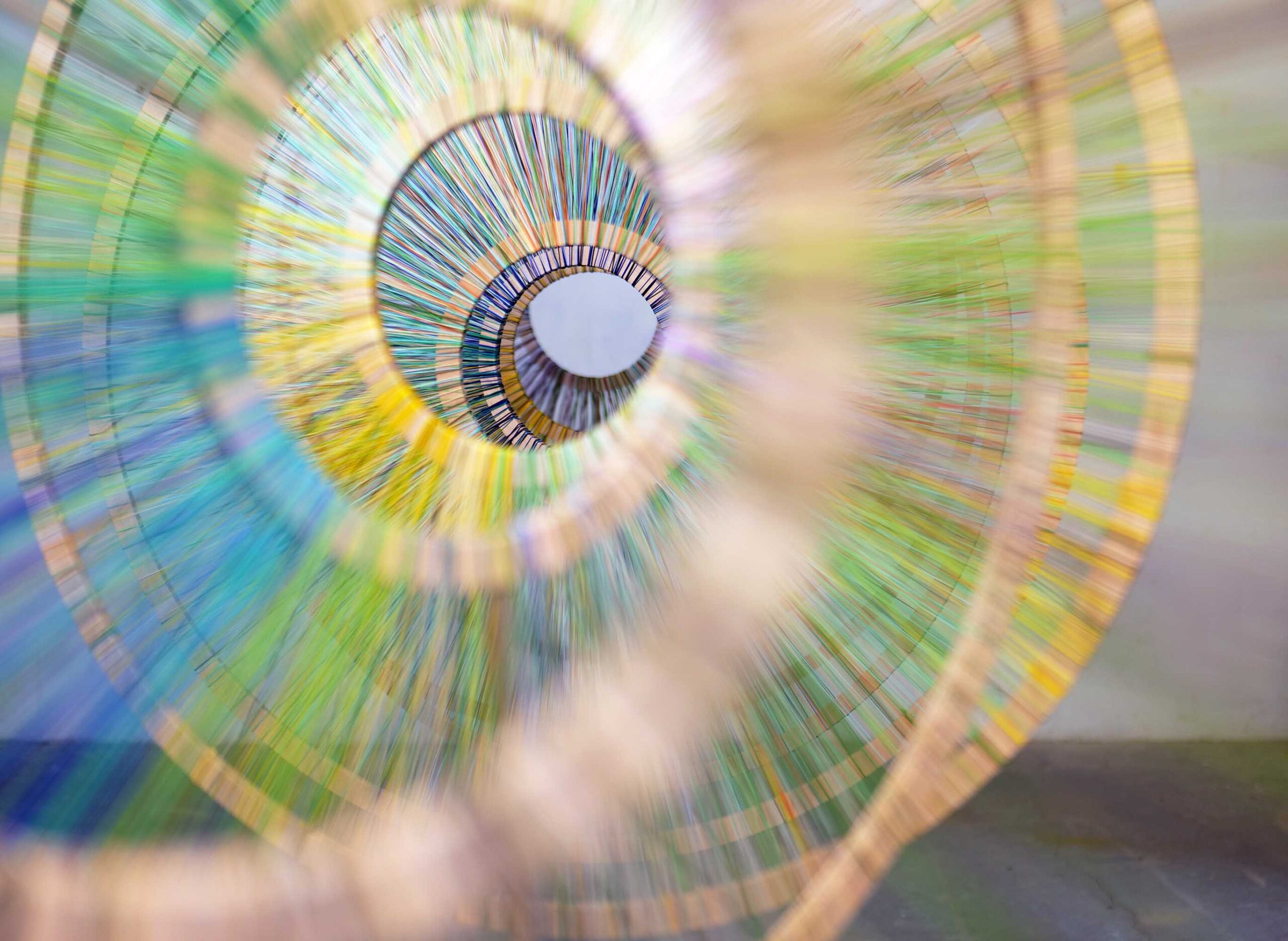
Olimpia Velasco has created a site-specific installation inspired by the ideas of sphericity and beauty described by María Zambrano in Claros del bosque [Forest Clearings].
Olimpia’s deep connection with the forest, a place of refuge from harm, is a constant, intensely desired priority in her life.
The installation is the result of paying intense attention to the forest’s sonic and visual fabric. Working from photographic sequences and following a nonhierarchical notetaking process, the artist paints threads as though she were weaving them, before placing them in hoops. By translating the idea of the clearing into the vertical plane, these newly formed spheres make us leap beyond the vicious circles that entail a loss of experience.
These pieces work on multiple scales and are as interdisciplinary as ecological interactions.
Olimpia Velasco activates the white cube as a heartbeat of the forest—a place for the sense of smell amid aromas, for listening among languages and for forms of care without control. The artist celebrates the idea that beauty is possible in sphericity.
Who gives thought to harm? Olimpia does, at the vertices and corners of the white cube, which don’t exist in the forest clearing. Olimpia introduces a tactile, biological weight that goes unnoticed: sacks of seeds camouflaged against the gallery floor, just as the history of the earth is concealed within the rings of trees.
Between the painted thread and the tree ring, the different levels of the forest emerge.
For a long time, art has been rehearsing new forms of exchange, and forging a transversal critique of poetic reason, as a way forward for our new relationships with objects and the world. As volumes upon the Earth’s crust, we acquire dimension through infinite relationships of kinship and tenderness.
Olimpia Velasco, like fellow artists with long-established careers, draws atlases of the different forms of wisdom rooted in generosity. Working within ecofeminist culture, these artists offer a kind of preventive optimism in the face of the fatalism of the species.
Olimpia never relinquishes the experience of painting as revelation and duration, and her minimalist approach prevents her practice from becoming fossilised: nothing unnecessary is ever formalised, and it therefore has no place.
I discover references among the pieces, not the other way around. A multiplicity that never forgets the one-to-one, Anna Tsing’s collaborative survival narrated alongside Valerie Trouet’s studies of tree rings, the new modes of exchange that Kojin Karatani proposes for the world and the poetic reason with which Zambrano wrote life.
Velasco’s concern spreads like poetry, expanding the experience of a world in which the human species becomes gentler and takes on all the colours of the forest.
Olimpia installs two cylindrical sacks, coloured in tones that range from the clearest light in the forest’s highest canopy to the shades of decomposing matter.
The soundscape she recorded in the forest enters the gallery, presented alongside mountain ranges carved in wood, for situated and solitary listening of the spectrum of the forest’s sounds.
Olimpia Velasco (Madrid, 1970) holds a BA in Fine Arts from the Universidad Complutense de Madrid. She undertook the second year of her doctoral studies at the Technological Educational Institute of Athens and holds a diploma in Graphic Design from the Centro Español de Nuevas Profesiones in Madrid.
Her work combines painting and installation; many of her projects are relational and connected to the experience of community. Her solo exhibitions include “(des)HABITAR”, at the Palacio Quintanar, Segovia, 2025; “Especies Vagabundas”, at the Kaplan Gallery, Palma, 2025; “Geodesia”, in the galleries adjoining the Aljub de la Misericòrdia, Palma, 2024, and at the Instituto Geográfico Nacional, Madrid, 2022; “Muntanya Roja”, in the church of the Convent de Sant Domingo, Museu de Pollença, 2023; “Algunas cosas que vuelan por el mundo”, at Galería Nueva, Madrid, 2021; “La Montaña Mágica”, at Galeria Maior, Pollença, 2020, the Bai & Yun Art Museum in Moganshan, China, 2019, and WE COLLECT Madrid, 2019; “La Partida (acción de peso)”, in the church of the Convent de Sant Domingo, Museu de Pollença, 2018; “La Oscuridad”, at Espai Dipòsit, Casal Solleric, Palma, 2018; and “Friluftsliv”, at the Palacete del Embarcadero, Santander, and Galeria Maior in Palma and Pollença, 2017.
Her interventions in public spaces include Efecto Mariposa, at the Spanish Embassy in Brussels; Floating in the Air, at Düsseldorf Airport; and the project Antes del vuelo, in Paris.
She has received grants for artistic residencies in France, Italy and China from the Spanish Ministry of Culture, the Spanish Ministry of Foreign Affairs and the Institut d’Estudis Baleàrics.
Her work is represented in the Pilar Citoler Collection, the DKV Collection, Es Baluard Museu, the Diezy7 Collection at Swab Barcelona, the Instituto Geográfico Nacional and Düsseldorf Airport, among others.